 What do all of these Spalding Method curriculum titles have in common?
The Writing Road to Reading by Romalda Spalding
Teaching Reading at Home (or) Spell to Write and Read (and companion The W.I.S.E. Guide for Spelling ) by Wanda Sanseri
Phonics for Reading and Spelling by Bonnie Dettmer
Spelling and Reading with Riggs by the Riggs Institute
 They are all based on the Romalda Spalding’s method of teaching phonics and spelling.
Romalda Spalding was the author of The Writing Road to Reading, and she came up with an organized way to teach a very old and basic concept: Using the phonetic sounds of the letters to teach reading.
In the 1970’s many of us suffered through the new ‘sight-reading method’ of teaching reading. We were taught whole words. We memorized ‘the’ and ‘are’ because “they are sight words…. not phonetic in sound.”
So if this was the case and this new way of teaching was so groundbreaking, why did so many of us end up in the reading lab by the time we were in second or third grade? Because it didn’t work for everyone. In fact, it didn’t work very well at all. Mrs. Spalding created a method that was a very back to basics approach and a very successful one at that.
The Writing Road to Reading was written by an educator, for classroom teachers. It is thick, dry, disorganized, and seems to be missing ‘something’. All of the other curriculums I listed above were written to be companion pieces to WRTR, or stand alones that utilize the Spalding Method, but apply it practically for the home setting.
Since I have experience with only one of these, Teaching Reading at Home, and its companion The W.I.S.E. Guide for Spelling


Wanda Sanseri was a public school teacher who trained under Romalda Spalding.
She began homeschooling her own children, and in the natural development of her homeschooling, she adapted what she learned from Mrs. Spalding into her own curriculum, which she used with her own children.

THE METHOD
There are 70 basic phonograms which make up the English language.
Many reading or phonics programs teach most of these phonograms, but then teach many others as exceptions. Truth be told, there are so FEW exceptions in our language that it only presents confusion when we say “But this one is an exception” and give no explanation for it. Word lists abound, even for kindergarten, with ‘sight words’–words that well-meaning teachers SAY cannot be spelled phonetically.
An example is “the”, which is pronounced /THEE/, not /THUH/, therefore spelled phonetically! /th/ makes its second most common sound (the voiced /th/) and /e/ says its name at the end of a syllable. Many of the supposed exceptions were actually INVENTED by Americans’ poor ways of pronunciation! I am an American and I am guilty of the same.
The basis of the program are the phonogram cards and the student’s spelling notebook.
This curriculum is non-consumable, making it a very good investment, particularly if you are teaching multiple children over the years. The only replaceable components are a $1 composition notebook each year, and a red pencil! The parent creates their own notebook to use as a guide in helping the child create theirs.
I cannot stress enough the importance of creating this notebook!
If you are brand new to using Wanda Sanseri’s program, follow her directions in Teaching Reading at Home or Spell to Write and Read (whatever respective version you are using) and make your own notebook. Do this before you begin to teach it to your children. If the program seems confusing to you, or if you have had trouble in the past with all of those spelling rules and seemingly strange spellings of English words, you won’t be by the time you finish your notebook.
Just the process of copying all of the spelling lists into your own notebook, marking the phonograms, and copying the charts into it will teach you pretty much everything you will need to relay to your student. This is how I learned to use it myself.
Some suggestions for using this program from the beginning:
Get an age/skill appropriate composition notebook for your student.
This means wider lines with the dotted centerline. Mrs. Sanseri’s company, Back Home Industries, sells some, although I’ve not purchased them from there so I don’t know what they are like. I used to buy some by Roaring Springs, which they sold at my local Staples office supply store. Staples no longer carries these, but I was able to locate Roaring Springs Composition Notebooks at Amazon.com.
The Riggs Institute also carries some very nice ones for under $2.50 each. They also sell notebook paper with the dotted center lines though! One ream of that is about $12 if I remember correctly and when I did buy a ream (8 years ago) it literally lasted us until my big kids no longer needed the dotted lines. They used it for everything.
Don’t insist on your young one to do 20 spelling words a week.
I started out my kindergartners with 5 words until they were able to write more and attend longer. Then bump up to 10 words. The WISE Guide has the lists neatly divided into twenty words each, and those are divided again into tens.
D1 and I (in kindergarten, and with then-undiagnosed Autism Spectrum Disorder) did ten words at a time, and I dictated a sentence to him afterward for him to write. I also would have him make up his own sentence, including some of his current or past spelling words to make it relevant.
For example, the first 10 words of List B:
tan, can, so, no, pet, a, an, the, good, last
The sentence I dictated to him yesterday was: I can see the good cat.
He came up with his own sentence also: My tan dog is last.
Have your child read his/her words and sentences back to you.
After we do his spelling words, I have him read them back to me. Then we do the two sentences, and he reads those to me also. I have a set of Christian Liberty Press Phonics Readers, and he reads me a story from Book A after we are done with our spelling lesson.
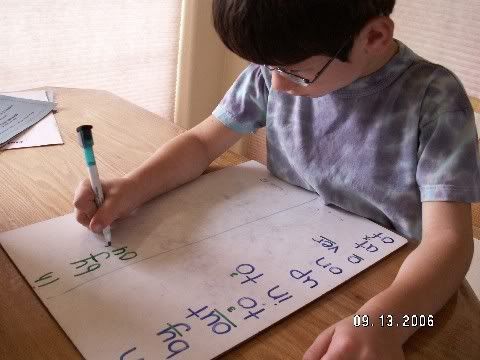
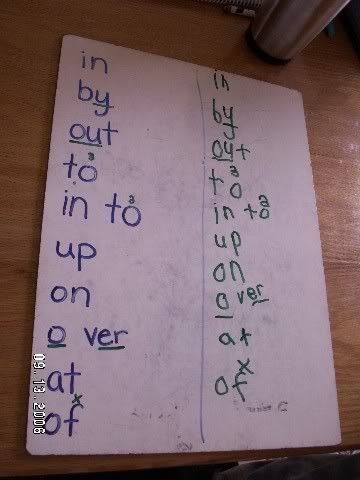
These pictures show how we started out doing spelling at the beginning of first grade.
I sounded the words out with him, writing them in a column on the whiteboard, and we would go over how to mark them. Review the spelling/marking rules they know as you do this.
Then, I’d just have him go back and copy each word and mark it correctly. My son has difficulty with his grip, and writing itself is a huge chore. If he’s having a really off day, then I don’t insist he does the writing but I will insist he dictate the spellings and explain the markings back to me.
Children need to develop language skills (written and spoken) while learning to read.
Dictate a sentence here and there, have your child retell a short story back to you (called narration by the Charlotte Mason fans), and talk about basic sentence structure- “We start a sentence with a capital letter and finish with an end mark- a period or question mark.” If it becomes a natural part of their reading and writing experience, the teaching aspect of it all will be so much easier later on.
If you take the time to learn to use this program, you will be rewarded tenfold when your children are reading fluently and spelling well.
Be assured that you will learn some things also, even if English was your strong point in school.
Call it whatever you want- spelling, reading, language arts. It is all of the above, and it is the one skill in life that no child, no adult, can live without. Reading and language skills are the keys to all other areas in life.
This post is linked at The Homeschool Curriculum Review Roundup

This was a totally unsolicited review because I love the program and have used it for years. No compensation was received.